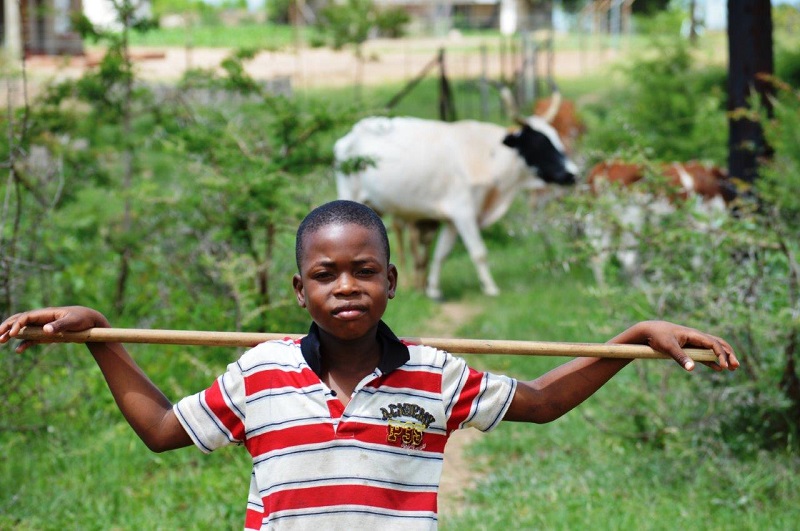
Since he became one of the youngest cow owners in his village, Ishmael Rapoloane’s hobbies have changed. The grade six learner used to play soccer and drive wire cars with his friends the whole afternoon after school, but now has channelled that energy into taking care of his cow.
“Now I feel I have something more interesting to look forward to when I come back from school,” says Ishmael.
He is one more than 10 children whose families were identified by World Vision through the Participatory Rural Appraisal Method conducted in the Vhembe and Mopani districts as very poor and earning no income. With this unique development approach, World Vision in Thusalushaka distributed cows to these families as a tool to empower them to improve their livelihoods.
Enhancing cattle development for poverty alleviation and improved livelihoods is widely accepted as a lasting solution to poverty reduction.
Nine-year-old Ishmael understands the treasure he has received; he has not only started working on a proper kraal for his cow, but has already given her the name Roomys, which means ice cream. “Roomys is going to bring us the nice life we have always desired as a family,” says Ishmael with a smile.
With the help of his uncle, he takes the cow for free check-ups conducted by the Department of Agriculture, which also provides cattle pest control products to ensure good health.
For his granny, Mapula Rapoloane, this means restored dignity for her struggling family. “Here in our village you are considered affluent when you have cattle, and now we will be counted among those people as soon as Roomys reproduces. We can use cattle for a number of purposes. They can be sold to pay school fees, buy clothing and meet other needs of not only Ishmael, but those of his four siblings too,” says the excited granny.
“By the time Ishmael completes matric, he should have about seven cattle, because these cows breed yearly. That means his university fees will not be a problem for his family,” adds WV’s Development Facilitator, Cedric Rachuene.