by Olwetu Mafutha
It’s just over a year since World Vision has started working in Orange Farm. This is one of the youngest informal settlements in South Africa, located approximately 45 km from Johannesburg. The inhabitants are mainly laid off farm workers.
Coster, 15 years, together with his un-employed parents and five siblings stay in a two room house, which was donated to them by the government as part of the Reconstruction and Development Programme (RDP). The main aim of the programme is to address the immense socioeconomic problems that exist in the country. However the government seems to be climbing an ever-ending mountain in this regard as poverty cycle widens in areas such as Orange Farm.
Coster father, 64 years and his 40 year-old mother have been unemployment ever since he was born. “In order for us to have food, my father makes zinc products, which my mother sells to the local people,” says Coster. In a good month the family pockets about R400 from these products.
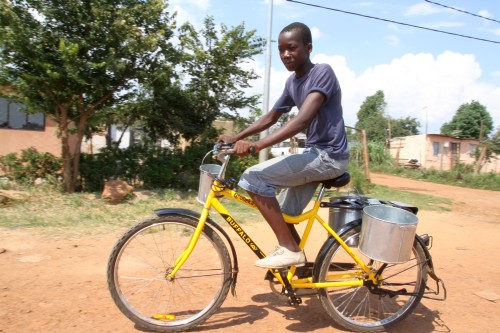
“Sometimes he does not make enough money to meet all our needs, ” he continues. Coster is one of more than100 learners from Thamsanqa secondary school in Orange Farm, who benefited from the Bicycle Education Empowerment Programme (BEEP) - rolled out by World Vision South Africa few weeks ago. And this has enabled the little man to be of great help in growing his father’s business. He assists with the transportation of the zinc basins, pots and containers produced by his father.
“Although the bicycle was given to him to ease transportation to and from school, it is proving to be useful in so many ways,” said Coster’s father. Adding the bike has brought about a big relief in transport costs. “Coster is the one who goes to buy our groceries now that he has a bike. And we are saving close to R50 per trip,” added Coster’s father.
His teachers have also reported serious improvement in his marks and commitment towards his studies.
As for Coster, getting a bicycle was a big surprise. “I did not expect to get a bicycle from World Vision, because we were told that our involvement in World Vision will empower our communities, ” he recalls.
Coster’s family situation is similar to that of 110 000 households in this township with a population of 400 000 people. Most households fall into lower- or middle-income brackets. And with the unemployment rate reportedly on the rise, children like Coster continue to suffer.
“The only thing that excites me right now is the arrival of World Vision in our area. I know there is more good things to come,” he said.
Coster’s mother hope that World Vision will empower unemployed women like her with basic business skills. “I would like to grow the manufacturing business that my husband is involved in, it has always been my dream to own a business and employ other people, and now with World Vision supporting us I know this will be possible,” said Coster’s mother.
World Vision’s Leader in Orange Farm, Ncobile Maseko concurs with Coster’s mom. “Given the challenges we have observed in this area, we have decided to make economic development our primary focus. We want to build capacity amongst community members so they are able to save money and understand issues of credit,” said Ncobile.
Coster’s two younger sisters and brothers are also set to benefit from a range of other education and child protection interventions to be rolled out by World Vision over the next few thirteen years.