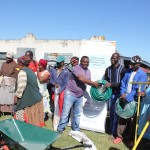
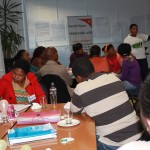
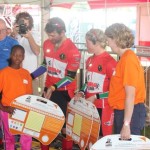
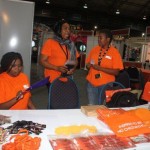
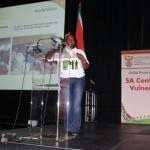
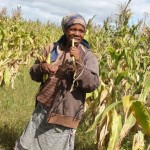
Youth leaders from Eastern Cape province attending a youth facilitation workshop, organized by World Vision
‘Take what is, and make it what could be’ – that’s what South Africans have decided to do. Youth from KwaZulu Natal (Umvoti, Umzimkhulu, Ixopo, Okhahlamba), Gauteng (Orange Farm and Orlando), Eastern Cape (Mbhashe and Nkonkobe) provinces in South Africa have started to bring about the change they would like to see in their communities. After receiving youth facilitation skills from World Vision, they have become the frontiers and catalysts of positive social changes in the neighborhoods.
Whilst social ills are on the rise in most communities in the country, there is also a rapid growth of appetite amongst the young minds to come up with more creative ways to deal with the challenges facing communities. “Young people in our time are grappling with issues such as drug abuse (sometimes linked to criminal activities), Satanism, HIV and AIDS, teenage pregnancy, abuse, etc., and I believe working together as young people we will find a solution,” said Khanya Gqumani, a Youth Leader from Idutywa.
Part of the training the youth received includes the Peace Road Curriculum, which empowers children and youth to learn life skills and resilience. “The training we provide is a life-long learning, during these sessions, the youth discuss and share on all sorts of pressures they encounter, so it helps them to broaden their thinking with regards to issues affecting youth,” said World Vision’s Thola Zulu-Solomon.
World Vision’s overall objectives are to empower young people for a productive life, raise youth role models for other youths, and develop healthy sexual awareness to help preserve this generation from HIV and AIDS. “The truth is that, as young people we are overwhelmed by the issues surrounding us. However, as this group, part of our task is to guide our peers, as they change and grow into productive adults,” said Tina Mdeni, Youth Leader from Mbhashe.
As change agents, this youth does not only guide other youths through changes, they are also expected to work with individuals, groups, and communities to improve the quality of children’s lives. “To do this, we are expected to change ourselves. We have been challenged to give up certain things, in order to enable our peers to copy certain qualities and lifestyle from us,” said Unathi Gqangeni from LoveLife. For Khuselwa Selana, a Youth Leader from Nkonkobe, a lot of introspection is necessary. “We must look at our own-selves and ask, Are we modelling the qualities we want to encourage in our peers and children? We have the multilevel task of being what we want others to be. Thus, the issue of youth development is interwoven with the task of our own development, “she said with conviction.
The move has been well welcomed by the church. “Young people should be at the forefront of change and innovation. Empowered, they can be key agents for development and peace. If, however, they are left on society’s margins, all of us will be impoverished. Let us ensure that all young people have every opportunity to participate fully in the lives of their societies,” said Pastor Leon Novoyi from Middledrift.
Other News Posts of Interest
- 16 Days Child Activism Campaign
- Traditional Healers’ Role in the Fight Against HIV and AIDS in Umzimkhulu
- World Vision Has Saved Me From Destruction..
 World Vision SA exhibits at the OVC conference at ICC, Durban
- Bicycles to Improve School Attendance in Thamsanqa Secondary School
- Adolescent Focused HIV Prevention
- Church Intervention Reduce HIV and AIDS Related Deaths in Umzimkhulu


 sending...