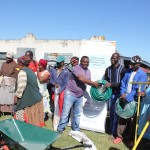
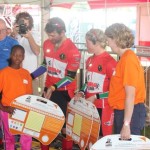
World Vision’s Manager in Nkonkobe - Siphiwo Gumenge and his team delivering garden tools to Nkonkobe community garden members. Local schools like Debe Marele have also received the same equipment and seedling.
Nkonkobe is a village situated in the eastern part of South Africa. It’s a community dominated by Africans, making up 99.5 per cent of the population. Agriculture is the main source of livelihood in this area, livestock production is also a key income role player when it comes to food security in this area. Like many other villages in the country, Nkonkobe is characterised by poverty and lack of employment opportunities.
HIV and AIDS is also a constant worry – parents pass on while their children are still at a tender age. Children that are left behind are usually picked up by relatives, and this puts additional pressure on these already impoverished and vulnerable groups. In many instances the relatives that are left behind to take care of the orphans struggle to make ends meet.
The high food prices have become one of the determining factors of household food insecurity; for they continue to erode the purchasing power of these poor households and contribute to a vicious cycle of poverty, food insecurity and malnutrition(more especially amongst children). All the while, the government’s ability to provide basic services has been challenged by the very slow pace of service delivery.
Many of the children affected by poverty in Nkonkobe are in World Vision’s programme, and the organisation has decided to intervene in a special way. To date World Vision has established and supports close to 30 community garden projects and 25 school gardens, and the community members are over the moon.
“Today we are proud to announce that poverty is the thing of the past in our area. Because of World Vision’s assistance, our children no longer go to bed hungry,” says Mthuthuzeli Vukani, a community garden member.
Sinesipho Caza, a grade 8 student, is one of over 800 learners who have benefitted from the vegetable garden established by World Vision at her school. Their school has recently received another batch of seedlings, and now it’s time to roll up the school shirts sleeves and work the soil.
“Whenever we receive these seedlings, we always take good care of them and they grow to be real vegetables,” Sinesipho says.
For World Vision, encouraging people to use their hands to produce food is one of the powerful keys that open the tanks of wealth. And the partnership that World Vision has established with the department of Social Development in Nkonkobe is bearing fruit. The crop farmers have been empowered with skills that will elevate them to commercial farming. They have also received much-needed gardening equipment, including seeds, fertilisers and agro-chemicals – all on the condition that some of they produce will go to the surrounding schools.
A total of 4, 000 children benefit from World Vision programmes in Nkonkobe. The overall objective for World Vision is to help sustain the livelihoods of children and communities and to minimize dependency of communities on government financial support.
Other News Posts of Interest
 A community maize farm curbs poverty in Mbashe
- A Community Maize Farm Curbs Poverty in Mbashe
 Planning for worsening weather conditions
- World Vision Responds to Chickenpox cases in Nkonkobe, Eastern Cape
- World Vision and Qhubeka Rollout Bicycles to Fight Poor School Attendance and Poverty in SA
 If you can’t feed a hundred people, then just feed one
- Bicycles to Improve School Attendance in Thamsanqa Secondary School


 sending...