Perhaps no other food has been more closely identified with the Africans than maize. And South Africans have not only adopted maize as a staple food in the diet, but have also developed a reverence for this kind of food. This is expressed in South Africans everyday rituals, religious practices, ceremonies and arts. In fact, very few people in the former Transkei can survive a day without a maize dish, with umngqusho (a dish made of samp and beans) being the favourate traditional dish of the Xhosa people. There is no doubt, corn forms part and parcel of everyday life in this part of the country.
These sentiments are shared by one of five Khawulezile Somdaka’s grandchildren. “We don’t worry about what to eat when we have maize. In the morning before we go to school, we make traditional porridge (made from ground maize) and eat pap (smooth maize meal porridge with thick consistency) when we come back”, said one of the grandchildren. One of the most popular maize dishes in this area is a more dry pap known as uphuthu – eaten with amasi (sour milk).
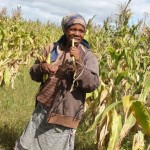
Due to its demand, maize is not so reasonable at the shops. And this has become a serious hindrance for parents, as many of them are unemployed. “Just one bag of maize will cost you not less than R70”, said Somdaka. This reality has prompted the 69 year old Somdaka and a group of four men and women in this area to start farming maize. With assistance from World Vision in Mbashe, the group has turned a 50 meter un-used land into green pastures.
The farming group is made up of fairly elderly people. But each is responsible for ploughing and cultivation of his/her portion of land in this promising garden. Just like Somdaka, many of these small scale farmers have been unemployed for more than 15 years before starting this garden. “After I was retrenched in a farm where I worked for ten years, I thought it was the end of my life. I did not even know what to do as I had already reached my retirement age”, he remembered. But now the father of five children with grandchildren, feels he has regained his dignity as a father, because he is now able to provide for his loved ones.
For Nosakhele Seyisi – a widow with four children, this initiative has redefined life. “I have never been employed in my entire life, me and my children depended on my late husband as he was doing part time jobs”, she said. World Vision has been supporting this project since last year. Plans to train the 50 members in business management and agri-farming are underway. “We have already engaged the Department of Agriculture with regards to the development of this project. Our plan is to formalize their business plan and train the members on how to run a proper business, so that it’s sustainable”, said World Vision’s Manager in Mbashe, Ernest Fraser.
Other News Posts of Interest
 A community maize farm curbs poverty in Mbashe
 Malnutrion becoming history in Nkonkobe, Eastern Cape
- World Vision and Qhubeka Rollout Bicycles to Fight Poor School Attendance and Poverty in SA
- Bicycles to Improve School Attendance in Thamsanqa Secondary School
- SA Getting the Basics Right on Child Health
- Soft Skills for Teachers, the Solution to Education Crisis
 A safe shelter for a rape survivor and her children


 sending...